Hello! If any of my (beautiful and sexy) readers are on Bluesky, i thought they might like to know that i’ve made a bot on there. It’s called @towns.satyrs.eu, and it posts a random British/Irish town (or village, or hamlet, or city) on the hour, every hour, give or take a few minutes. Like so:
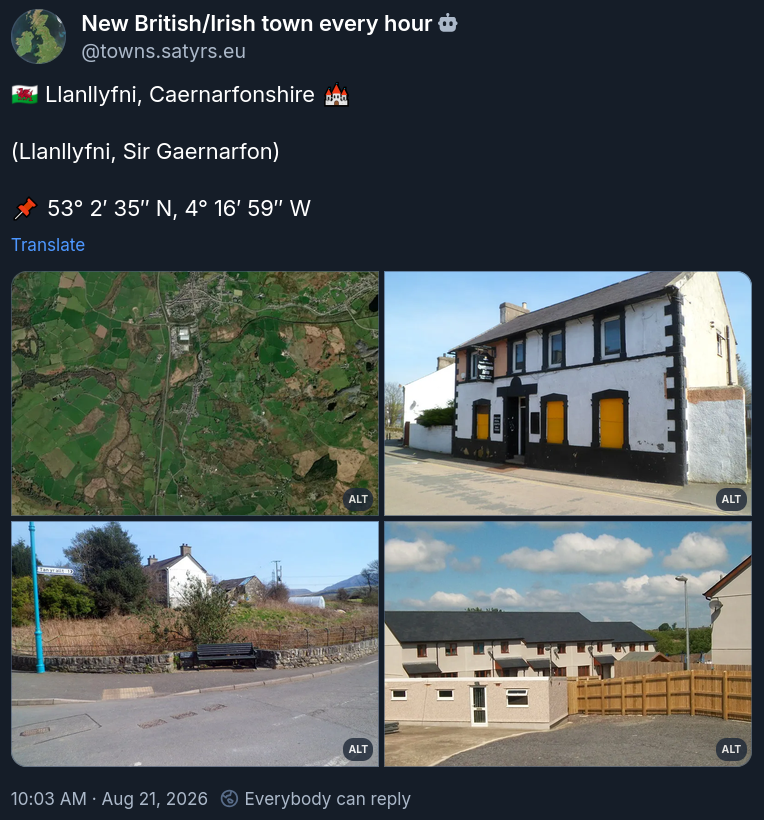
It’s inspired by the inimitable (okay, highly imitable) @townsusa.bsky.social, which does the same thing but for American towns. Here’s how i made it, in bullet-point form:
-
Place data
- From the moment i had the idea, i knew i wanted to use historic counties as the basis, rather than local government areas or the post-1974 bastardisations. I thought this would be a big hurdle — but, thankfully, the most comprehensive permissively licensed database on British place names out there, the Gazetteer of British Place Names, is maintained by none other than… the Association of British Counties! So that was easier than i expected.
- The Irish government maintains its own official dataset of population centres, including both Irish and English names. It’s a bit thinner than its British counterpart, but it serves nicely enough for our purposes. (I had wanted to use Logainm.ie, the even more comprehensive dataset of Irish-language place names, but there didn’t seem to be any kind of download button anywhere… alas!)
- For crown dependencies and overseas territories, i scraped data from OpenStreetMap using the Overpass Turbo API. It comes with its own bespoke arcane query language, but thankfully it’s 2026 and you can just get your friendly local server farm to write your queries for you instead of learning it yourself for questionable future gain.
- OpenStreetMap also sourced most of the Welsh, Cornish, Scots Gaelic, and Irish place names for the UK, where the ABC’s gazetteer was frustratingly thin on the ground.
-
Pretty pictures
- The satellite images are sourced from Mapbox, whose API has a very generous free tier if you can stomach giving them your card information.
- Wikimedia Commons, incredibly, lets you search images by geographical location. The bot asks for the fifty nearest photos in a one-kilometre radius, then picks three from that list at random. (This avoids naïvely picking the three nearest and thus ending up with three pictures of exactly the same thing.)
- Descriptive alt text is generated for the above by Google’s Gemini 3 Flash. At about a fifth of a pence per post — £17.50 per year, otherwise put — i’m hoping it won’t burn too much of a hole in my pocket.
-
Posting
- Posting goes through Bluesky’s native ATProto API, whose documentation even starts with a helpful tutorial for setting up your first bot. That’s nice of them.
Anyway, that’s all. Enjoy, and do give the bot a follow if you wish!