Good evening, “Greece” was a 1000-year social experiment conducted by Oxford’s classics department. Thank you for your coöperation.
Page 14
2008 Tom Scott video: The First Annual Yorkshire Pudding And Spoon Race
2013 Tom Scott video:
The Blinking Light That Keeps Pedestrians Safe
2018 Tom Scott video: I Got To Go-Kart Around A
Particle Accelarator
2023 Tom Scott video: It's like a TARDIS for foxes.
Well, i rode it out for three years, but i finally caught covid. o7
Movie review: Goncharov 2 (Gonchathon day 37)
The internet was lit ablaze last year with the rediscovery of Martin Scorcese’s obscure masterpiece Goncharov, and it’s easy to see why. Accessible yet complex, of its time and yet progressive, it was ripe for a critical reëvaluation.
What people don’t often hear about is its sequel — one that Marvel’s biggest fanboy didn’t even know existed. The rights having fallen into the lap of the bloated corpse of Cannon Entertainment, they dumped it straight to video in 1989, leaving it to be forgotten.… until now!!!
Goncharov 2: The Quest for Gonch (sold in the USSR as The Quest For God) is the biggest piece of shit since the fat one i laid in the McDonald’s deep fryer last weekend.1 The Gonch himself is no longer played by Robert DeNiro — clearly too good for this shit — but an up and coming Danny DeVito, wearing an unconvincing latex mask which sits somewhere in between Tom Cruise in Vanilla Sky and that one I Think You Could Leave skit.
Personally, I think this was one of Devito’s better roles. Casting Devito to replace Deniro was an odd choice, but that’s what happens when the Farrelly Brothers direct a mafia film.
Yes, this was the Farrelly Brother’s first picture. They tried taking a more serious film for their first work, but it falls flat on its face in many places. I found the scene where the Gonch huffs thirteen cans of glue to be quite amusing for all the wrong reasons. Devito put his heart—
I neither know nor care who you are but please stop defending The Quest for Gonch™. The Goncharov Cinematic Universe does not need this sort of slander, and neither does this blog!
Listen, there is TONS of potential for the Goncharov Cinematic Universe to expand from this film. It’s not the best film, sure it’s… well…
…..
…well, it is definetly2 a film.
Well if you’re going to get technical, it’s not a film! It’s a video! I’d say it was shot on a potato, but that’s an insult to potatoes — when you compare it to the beautiful composition of Gonch 1™’s ending clock shot, this was shot on a yam.
Ok, sure, the picture quality wasn’t the best, but I’d blame that on the film’s rushed development. It was first approved by Scorceses in the late 1980s as a fallback in case he was killed by a conservative lynch mob during the production of The Last Temptation of Christ as a fallback.
You have no understanding of the complex lore behind /The Quest for Go(nch|d)/, you
absolute fucking nitwit. You fool. You Fucking Nimrod.
The Last Temptation of Christ was released in 1988, and Concharov II was released in 1989—
Martin Scorcese had no involvement in this. This was that fucker Matteo Bunchofnumbers’ idea. You know how i know that? Because if Martin Scorsese knew about the existence of Goncharov 2: The Quest for Gonch, he’d have not only killed himself, but figured out how to kill himself twice.
You’re half-right; he had no involvement in the film, but he did approve its creation solely to profit off of any VHS sales. I know this because a friend’s cousin’s nephew’s sister-in-law’s boss’ son’s great uncle knew a guy who worked for the Cleveland Plain Dealer and did an interview with Scorsese not long before the film’s release.
I guess killing yourself twice just results in you coming back to life. Look — regardless of Marty McFly or whatever his name is’ affiliation with it, can we focus on the end product? I mean, that scene where Kremlinova trips over her high heels in that blue dress, and then when it cuts to the next shot, it’s orange! Orange! Don’t you try and fucking pretend it’s some deep symbolism that predicted the rise of every movie poster in the 2000s, it’s just the director having a fucking washing sponge6 for a brain!
Actually, I thought it was one of the more insightful scenes of the film. The dress colors symbolize
the slow and gradual fall of Russian society from great pride in an idealistic world to the growing
realization that said utopian dreams will never fruition, and the subsequent moral collapse
127.192.34.27 therein.
They could’ve used a better dress for the scene, though.
73 West Boulevard, Ocala, Florida8
So then Goncharov gets aids. You know — given how tenderly G1 / Gonch Wick Chapter 1 handled its gay love scenes, there’s a real opportunity there! But since this is being directed by Thomas Ouiseau (no relation? I think?), he “catches aids from a government cactus”, starts coughing up blood, and immediately says “i have the aids” and dies. Yes! I’m writing over you! Fuck you!
My least favorite part of the film would be the scene where Goncharov punches an Albanian consort woman. It was not necessary to the plot at all, and just felt like a dated excuse to throw in a bar fight scene. Oh my god, are you seriously writing over me? Wha- how is this even possible?
Fine, you know what, here.
You’ve heard of Marsyas and Applo before, right?
You’re in Comic Sans now.
hhhNOOOOO
You know what, hang on, this is my blog. I don’t have to put up with this crap. I can just tell you to leave. Or whatever.
That feels rude, actually, now i think of it.
I was never invited, so telling me to leave simply doesn’t work in the first place. Algorian logic. Pretty deep stuff interdimensional. Don’t think a normie like you would understand.
Look, can we just agree on a rating out of 10 and then go? The people need to know if G2® is worth the purchase!
…
0.85/10.
I think you’re being too nice with that 0.85. I mean, what is this? IGN?
Thrembo/10. Too many overly long sex scenes.
That’s not even a real number. Not since the incident.
Anyway — i give Goncharov 2: The Quest for God (God never shows up, incidentally, unless you count the Kandinsky painting in the beach scene) an (eiπ+1)/10.
I revise my earlier rating. Rational numbers are better for ratings.
I give the film a -b±√(b²-4ac) 2a/10. Has the potential for greatly expanding the Goncharov universe, but its attempts at being both a psychological thriller and a slapstick humor film wrapped into a mafia film are simply too confusing for most viewers.
Thankfully, the first Goncharov11 film on VHS was also the last. And it’s stayed that way ever since. (We don’t talk about the Blockbuster trilogy.12) Good night.
Mx Tynehorne’s link roundup, volume XXII: emergency edition
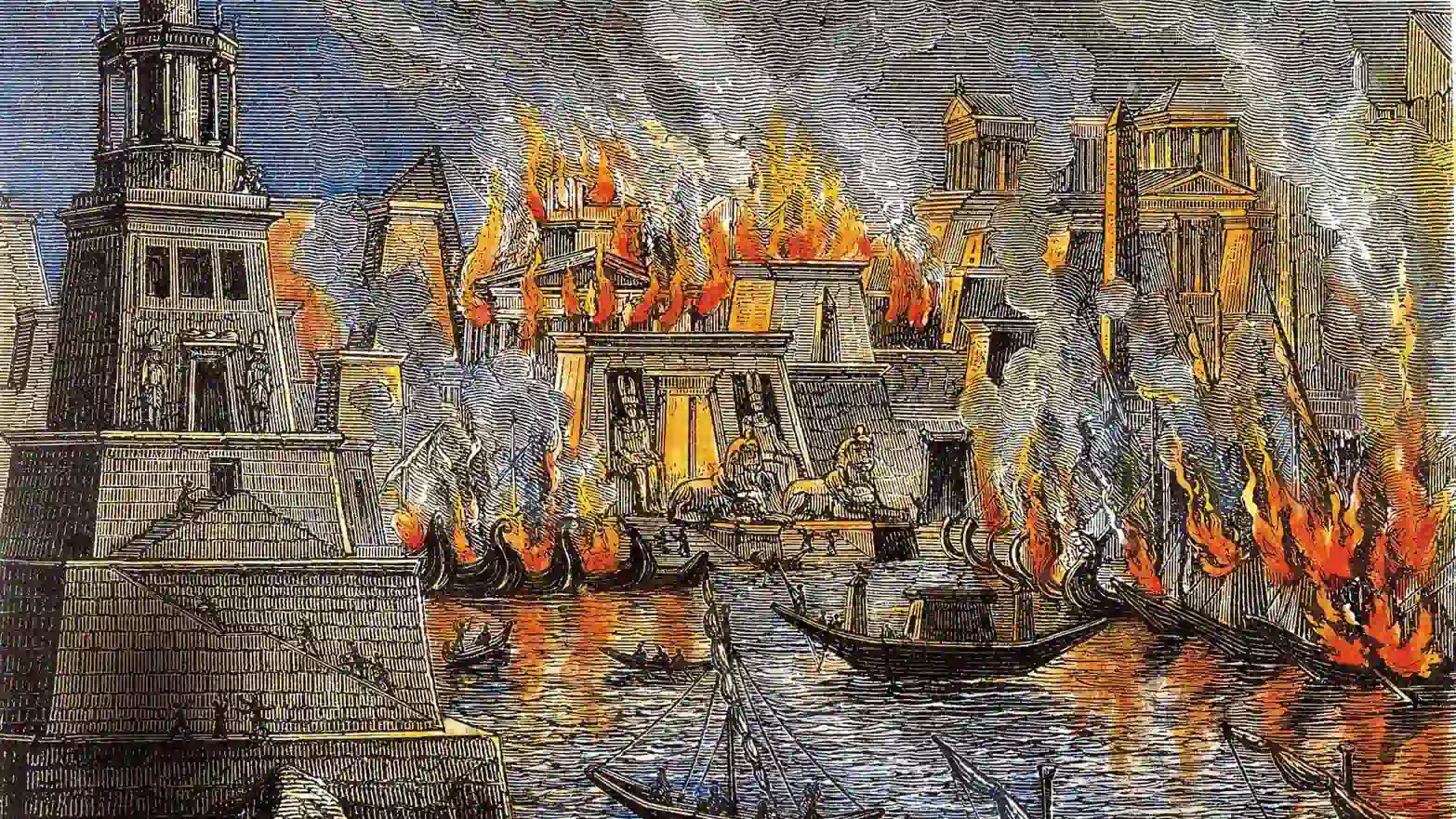
I hate this sort of thing, you hate this sort of thing, let’s get it out of the way. In addition to capturing old web pages, the Internet Archive is also home to untold thousands of old videos, games, and books — each of the latter of which correspond to a real, physical book in their collections. They lend them out like a library, for only one person at a time… until the pandemic, when they made the perhaps ill-advised decision to lift the borrowing limits for that limited time. Publishing companies, who weren’t too happy with that, pushed the nuclear button, sued them over the entire idea of digital lending, and now a federal court’s decided against them. They’re planning to take the fight as high as they can go — and they could use your donation.
As i said, i hate to do this — you don’t need me to tell you about all the ways the world is fucked up — but i’m willing to make an allowance when it affects me in particular. So many pieces of internet history, even on this site, now only exist as digital ghosts in their machines (hell, i even had to replace one of the links here with an Archive.org link after the author was suspended from Twitter). And i can’t count the number of musty out-of-print books that i would have never been able to access here from my comfy chair in England if it weren’t for the IA preserving them for a new generation.
So please — toss them a few bucks and protect our history.
Anyway.

The uncanny-valley tendencies of AI should be used to innovate and create new, terrifying non-binary genitalia, neither male nor female but a horrifying third thing the likes of which homines sapientes have never before seen
Movie review: Vanilla Sky
Title of movie: Vanilla Sky
Year of release: 2001
Starring: Tom Cruise
Director: “Cameron Crowe” (possibly Tom Cruise in a latex mask)
Plot: Rich prick gets in a car accident, has some nasty dreams, and then Mr Exposition shows up in the great glass elevator from Charlie and the Chocolate Factory in the last 10 minutes to explain everything
Director’s taste in music: Same as mine; you can tell because this film has like fifteen pointless needle dropsa
Does it contain a Tom Cruise Triathlon™?b No, although he does do a Tom Cruise Run™ at least once
Does it at least have good ideas? It has the germs of things that might be called ideas, but none that haven’t been done better before
Overall review:

My first love
When i was eleven, my dad told me to come downstairs. (I was on holiday at the time, you see, on my semiannual Divorce Custody Trip® back to the fatherland, where i could gorge myself on as many sweets and spit out as many cuss words as i wanted.) He had something to show me on his home cinema setup.
Normally it would be some documentary about watchmaking or nuclear waste storage or any number of things that took his fleeting fancy. Neither of us were much for fiction, and my young self especially wasn’t much of a cinephile. I don’t think my taste in movies had updated much since i watched Finding Nemo on a loop at age three.
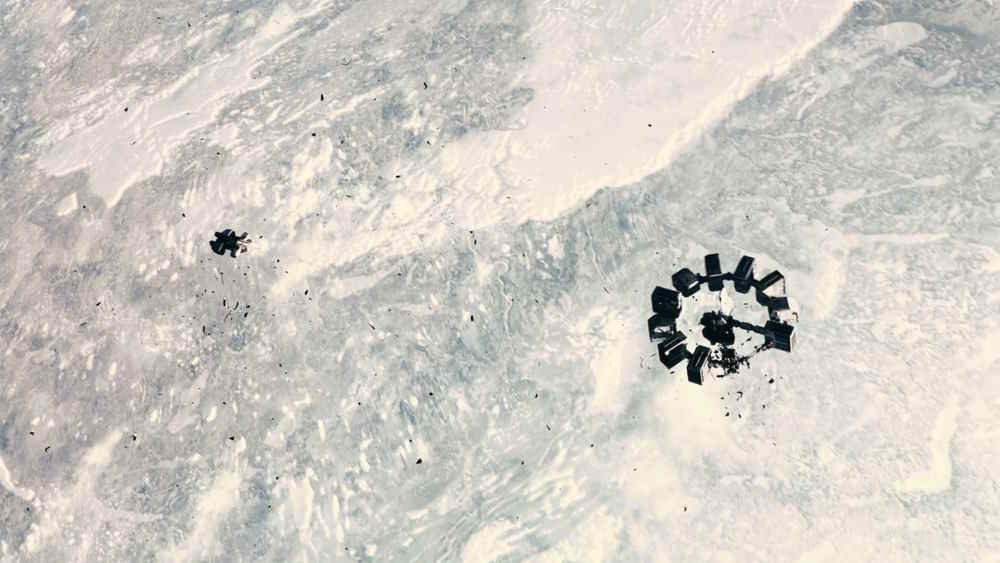
Two and a half hours later, there i was, on his lily-white fake-leather sofa, my jaw agape, needing a lie down to take it all in. That was the day i met my first favourite film: Interstellar.
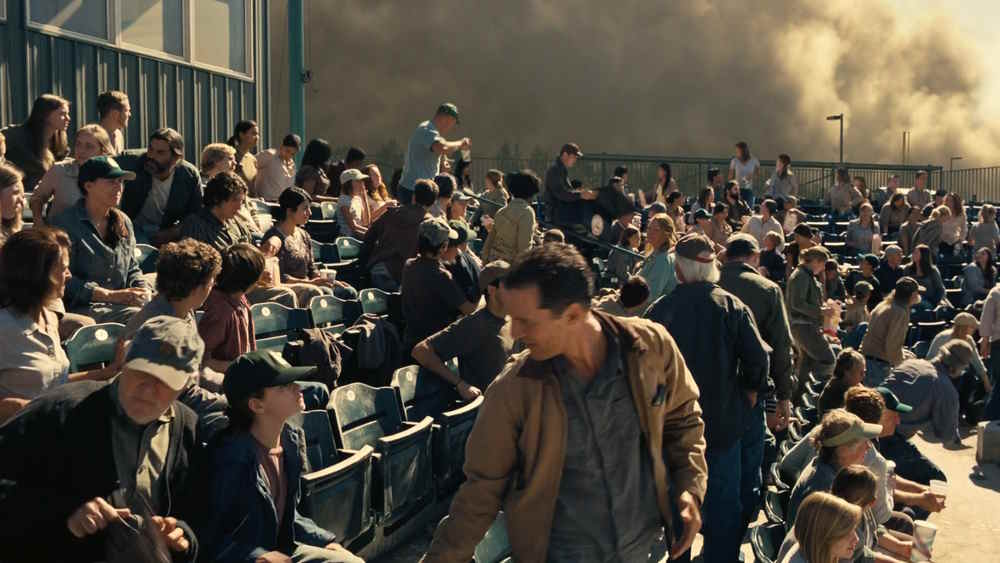
Christopher Nolan has a reputation for mind-bending bombast, but his directing is actually quite plain when you get down to it. His palette of colours would be more at home in a hardware store than an art department.a He has little time for the fancy camera trickery so beloved by his fellow mass-market auteurs like Spielberg and Zemeckis. He shoots his pictures as they are, not as a painter might like them to be.
It works to his detriment as often as in his favour. The Dark Knight trilogy’s dedication to surgically removing every ounce of colour and whimsy from its inherently campy source sucks it dry of life and fun. (Whenever Heath Ledger isn’t on screen, all the other characters should be asking, “where’s the Joker?”) But in the intervening years, it seems that Mr Nolan figured out how to use his un-style to his advantage.
On Earth, he shoots everything like, well, a Christopher Nolan film — a look that perfectly suits such a drab, dying world of omnipresent dust storms and weltering crops. When the plot shoots past the stratosphere and into the stars, he anchors his fantastic alien worlds and black holes of tantalising beauty against that same pedestrian style; devoid of his peers’ tricks and flourishes, you get the sense that if his gargantuan star-eaters and tome-tiled tesseracts were real, this is exactly what they would look like.
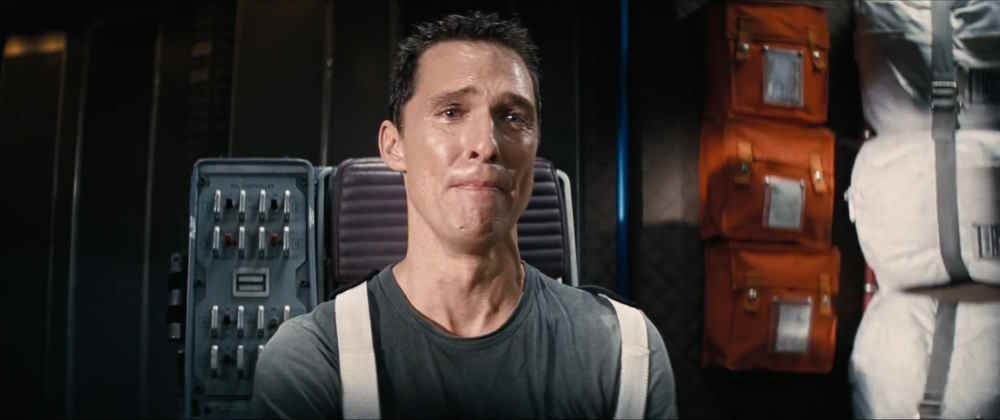
Much has been made of Interstellar’s Achilles’ heel: lurve. I'd like to offer a lukewarm defence. Many take Anne Hathaway’s speech about love as a force “transcending dimensions of time and space” as exposition, seeing her character, Amelia Brand, as a simple mouthpiece for the Messrs Nolan’s hamfisted platitudes. I would call this a severely mistaken interpretation.
Dr Brand’s lines come at the lowest point in her life. She has spent years — decades, from Earth’s view — floating alone in space; now, the crew have to decide how to use their one remaining shot to save all mankind. She isn’t making any profound statements or logical arguments. She is desperately trying to explain to the two men beside her why she thinks, right or wrong, that they should take the risk and visit her former lover’s last known location rather than the closer world the other two prefer. It’s clunky and melodramatic, but that’s the point: she’s grasping at straws, willing to do anything to see her love again. Her speech gives balance against her comrades’ assumption that cold, hard logic is all that matters, throwing gut feeling and emotion out the airlock.
When Cooper falls into that black hole and finds himself wall to wall with a myriad versions of his daughter, it isn’t some literal fundamental force of “love” that brings him there. It is his acceptance of Dr Brand’s romanticism over Mann’s enlightenment. Cold calculations have brought him nought but ruin, forcing him to watch his daughter grow up in front of his eyes and nearly killing both him and the whole human race; so, he lays down his mask, dives into what science tells him is certain doom, and lets the man who wept at those 20 years of messages take control.
I’m not sure that it all comes together in the end. Matthew McConaughey is a fine performer, but the role of Cooper deserves someone who can give it the gravitas (heh) and sensitivity his trauma deserves — not just screaming “Murph!!!” over and over. Mr Nolan’s script is utilitarian as ever; misunderstood as it may be, Dr Brand’s tangent fits into the rest of the film about as well as a cat fits into a baseball glove.
That slack-jawed night on the sofa would begin a new tradition. Every time i shuttle back and forth between England and Holland, i queue up Hans Zimmer’s score on my earbuds, and try to time it juuuuust right, such that the second the jet takes off, “Mountains” comes to its peak or “No Time for Caution”’s organs begin to blare. There’s a lot of flicks i like better these days — Interstellar would probably barely scrape the top ten — but there’ll always be a warm place in my heart for my first love.

(Guy who writes headlines for newspapers) I love Ben, Jerry's
Mx Tynehorne’s link roundup, volume XXI
- The King Crimson wars
- Most Apple TV+ shows look fake, but this Tetris movie actually looks pretty good
- The Corridor crew break down Avatar 2’s visual effects
- Stargate’s surprisingly accurate Ancient Egyptian
- The Oakland Buddha, or, in which a Buddha statue does a better job at stopping crime than the Oakland police department
- Joe Rogan goes to the beach that makes you old
Affleck’s Palace: tidbits from Manchester


It has now been over three months since i visited the city of Manchester. What once was a vivid memory has been obscured by the fog of ever-ticking time. But there is unfinished business to be dealt with — so let me sing to you, dear reader, of Affleck’s Palace.
Cottonopolis’ pop- and counter-culture mecca found its place in a bourgeois defunct department store; its hollowed husk has been stuffed beyond recognition with dozens of stores over four floors, from fashion to cassettes to Hatsune Miku–themed fizzy pop.

It’s an absolutely disorienting place to get your head around. The meme up in Newcastle is that the Grainger Market is an Escherian nightmare where nothing is ever where it was last time, but Affleck’s is a whole other level (three of them, in fact). Stairs lead to more stairs which lead to corridors which somehow lead back to the same stairs. It took me five goes to find the cassette tape store, and when i did, it was closed for a fag break. It’s the sort of place where a non-specifically foreign woman who you never see again sells you a cursed trinket that brings ruin to your family.

I can only tolerate hippie shit in small doses, and, thankfully, this little bath-bomb dispensary was the perfect small dose. Incense sticks? Tie-dye decorations? Sure, why not.

This shop claims to be Europe’s largest LGBT specialty store, which i’m sure is true, if only because half of Europe has the same attitude towards gay and trans people as a moderate Westboro Baptist.

And if counter-culture isn’t your thing, there’s enough stalls hawking Disney merchandise to keep you occupied. (I clapped when i saw the thing i know!!!)
I hardly even remember getting in or out of the building, which leaves me at a loss for how to end this post. Maybe it’s more of a feeling than a real place — you just wake up one day, teleported inside, and have to complete a vision quest to buy a cone of rose-flavoured ice cream to find out how to leave.
![Meme captioned "Holy shit!! Is that a motherfucking [Newcastle upon Tyne] reference???" surrounded by various things which almost look like things from Newcastle](/garden/media/holyshitreference.jpg)
Where the United States got their names

Mx Tynehorne’s link roundup, volume XX
- Wikipedia’s list of works based on dreams
- The Stem Projector is the kind of ridiculous gadget i’d think up when i was seven, with no regard for any practical value or market — haptic channel surfing! Instagram filters for movies! Automatically-generated mood boards! Just complete nonsense and i want it now.
- “The Stink A”, or, why Kiwis have trouble typesetting Māori
- “The R.D.D. Nickel Atlas of the Universe”
-
Oops, all Youtube!
- In the spirit of every Youtube video since 2016, i would first like to say that this segment is brought to you by Sponsorblock. Begone with those crummy razors and earbuds!
- How HD TVs ruined sitcoms (12′)
- Mobile gaming is the definition of wasted potential (17′)
- Garfield lore (16′)
- The origins of cursed images (12′)
I had a religious experience yesterday
I had a religious experience yesterday.
It’s a common metaphor. A playful exaggeration of what happens when something goes beyond a mere dopamine hit and passes into complete shamanic bliss.
If most of the people in the crowd there with me had said that, they wouldn’t have meant it literally. They’re atheists. Christians. Muslims. “Spiritual, but not religious”. Either they see no point in all this God-bothering, or their spiritual needs are well accounted for.
As for your correspondent? Well, loud, boisterious ecstasy is
exactly the type of old-time religion i’m after. Hundreds of sweating, screaming, beautiful humans,
swimming in the sea of each other, without a care in the world, freed, just for a moment, from the
stresses of their mundane daily life1 — and all led by a charismatic
preacher front man. What else could you call such a thing?
When you’re a shy bairn who follows a dead religion, you take what you can get.
Also… about halfway through the show, the band put up a big caption on the side screens saying “guest starring Harry Styles”2 (greeted with rapturous applause). They then proceeded to bring out Lewis “iwageddicannaustibeisumwunyuluuuuuuh” Capaldi instead (greeted with considerably less rapturous applause), and have him sing the absolute holy grail of 1975 concerts: “Antichrist”, a song from their very first EP which the band have steadfastly refused to ever play live. Masterful trolling.